ASO in 2026.
9 factors that matter.
What actually moves App Store and Google Play rankings in 2026. From keyword strategy to creative testing to the quiet metric that beats everything: install conversion rate.
ASO in 2026 is mostly conversion, not keywords
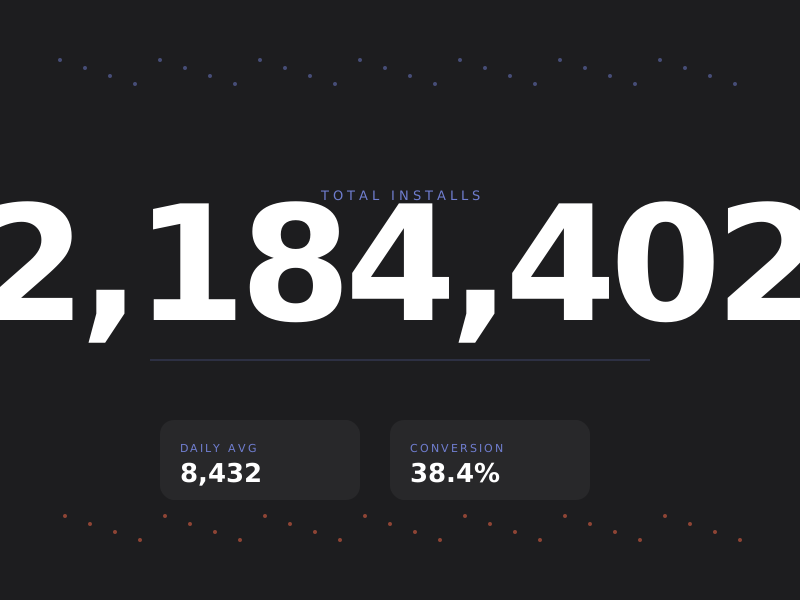
The biggest mental shift in app store optimization over the last three years: keywords matter, but install conversion rate matters more. Both Apple and Google now heavily weight what they call "installs per impression" — the percentage of people who see your listing and tap install.
A page that ranks #5 with 30% conversion will outperform a page that ranks #2 with 10% conversion. Every time. Both stores have figured out that conversion is a much better signal of "is this the right app to show this user" than ranking position alone.
The implication: don't fight for keyword #1 if your listing is mediocre. Make your listing great first, then climb.
1. Title and subtitle (still the heaviest)
The title is the single most important ASO field, both for ranking and for conversion. You get 30 characters on iOS, 50 on Google Play. Use them precisely.
Best practice: brand name + 2–3 high-volume keywords that describe the core function. "Strava: Run, Bike, Hike Tracker" or "Notion: Notes, Docs, Tasks." Don't keyword-stuff. Both stores penalize spammy titles, and so do users.
Subtitle (iOS) and short description (Google Play) get less weight but still count. Use them for the second tier of keywords you couldn't fit in the title.
2. Keywords field (iOS) and full description (both stores)
iOS gives you 100 characters of hidden keywords that don't appear publicly but feed the ranking algorithm. Use commas, no spaces, no plurals (the algorithm handles plurals). Don't repeat words from your title — wasted space.
Google Play has no hidden keyword field but reads the full description for ranking signals. Mention important keywords 3–5 times across the first paragraph. Don't stuff. Write for humans, but with awareness of the keywords you want to rank for.
3. Icon
The icon is the highest-leverage creative asset in your listing — and the most under-tested. A better icon can lift install conversion by 15–25% in a week. We've seen icon redesigns drive 40%+ install lift on apps with previously generic icons.
Test ruthlessly. Apple's PPO and Google Play's experiments tool both let you A/B test icons. Run a test every 4–6 weeks. Most categories converge on similar visual patterns (productivity = clean shapes, fitness = vibrant gradients) — but small departures from the category norm often win.
4. Screenshots
The first 2–3 screenshots drive the install decision for most users. They never scroll past. Optimize accordingly.
Best practice: each screenshot communicates one specific value proposition with a clear headline. Avoid pure UI screenshots — they're boring. Use captions that translate features into outcomes. "Track every workout in seconds" beats a blank screenshot of the workout screen.
Test combinations. Different audiences respond to different value props. Custom Product Pages (iOS) let you show different screenshot sets to different paid traffic sources. Heavy users, casual users, sceptics — they each respond to different framings.
5. Preview video
Apple's preview videos auto-play on most devices. A good preview can lift conversion 5–15% over screenshots alone. A bad one can hurt — make sure the first 3 seconds are unambiguous.
Keep it short (15–30 seconds), no audio narration (most users have audio off), captions only, focus on outcomes not features. Show the app actually being used, not abstract animations.
6. Ratings and reviews
Ratings affect both rankings and conversion. Below 4.5 stars, conversion drops sharply. Below 4.0 stars, both stores deprioritize you.
Build review prompts into your in-app moments of delight. Right after a user completes their first workout, finishes their first project, hits their first milestone — that's when you ask. Never ask cold or after a frustrating moment.
Respond to negative reviews. Both stores reward developers who actively engage. A thoughtful response to a 1-star review can convert a sceptical reader of that review into an installer.
7. Update cadence
Both stores reward apps that get updated regularly. Even a minor monthly update sends a signal that the app is actively maintained. Stagnant apps get demoted in rankings over 6–12 months.
This doesn't mean shipping junk to game the algorithm. It means a real, ongoing maintenance cadence — bug fixes, OS updates, small feature additions, performance improvements.
8. Localization
Localization is the single most underused ASO lever. Translating and locally-optimizing your store listing for the top 10 markets typically lifts global installs 20–60%. Most teams skip it because it feels like work. Worth doing.
Don't just machine-translate. Hire a native speaker who understands the keywords people actually search in that market. The Korean keyword for "fitness tracker" isn't a literal translation — it's whatever Koreans actually type into the App Store. That's worth getting right.
9. Install velocity (the secret sauce)
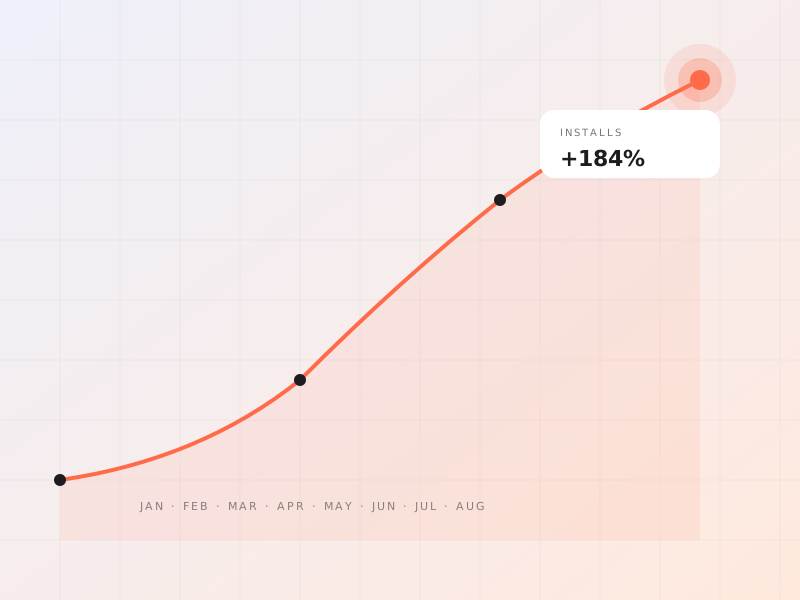
The most important factor that nobody talks about openly: install velocity. Apps that suddenly start getting more installs than yesterday rank higher tomorrow. Both algorithms reward "this app is gaining momentum."
This is why ASO compounds with paid UA. A burst of paid installs often kicks off an organic ranking improvement, which drives more organic installs, which feeds back into the ranking. Not a trick — a real positive feedback loop. Time your paid spikes around your ASO improvements to maximize the bump.
The corollary: if you have a feature launch, a piece of press, a viral moment — pour gas on it. The 48-hour window after a velocity spike is when the algorithms reward you most.
Where to start
If you're auditing your own ASO right now, the highest-leverage three things to do this week:
Test a new icon. Even a small improvement compounds across every other channel.
Localize for your top 5 international markets. The work is mostly translation cost; the install lift is structural.
Set up a review prompt at a moment of in-app delight. Higher ratings unlock everything else.
Beyond that, ASO is a quarterly discipline, not a project. The brands that own their categories on the App Store treat it like SEO — ongoing, instrumented, with weekly reviews and monthly experiments. The ones that don't, drift.