AI search traffic.
Where it goes from here.
The brands winning in AI search aren't gaming a new algorithm. They're publishing content that actually deserves to be cited. Here's the practical guide.
Search is no longer just Google
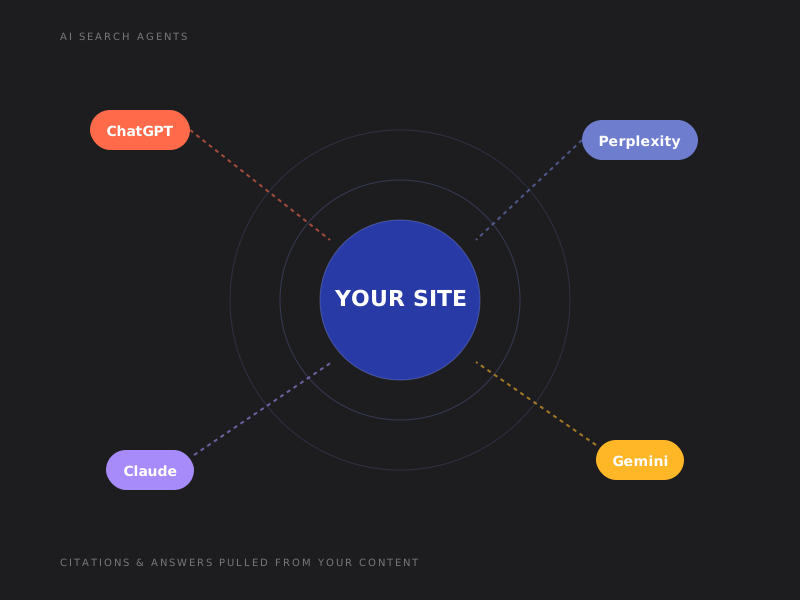
Three years ago, "search engine optimization" meant optimizing for Google. That's no longer the whole picture. ChatGPT now handles 800+ million weekly queries. Perplexity, Claude, Copilot and Google's own AI Overviews answer roughly a third of informational searches without sending a click to any website.
This isn't an existential threat to SEO. It's an evolution. The brands that adapt early will win the next decade of organic acquisition. The brands that ignore it will quietly bleed traffic over the next five years and wonder where it went.
The new game: optimize to be the source AI tools cite. The acronym people are using is GEO (Generative Engine Optimization), but the practice is mostly an extension of good SEO — with a few specific shifts in emphasis.
How AI tools actually pick what to cite

AI search engines aren't running mystical neural networks that read your soul. They're doing four things, in roughly this order:
First, they retrieve a set of relevant documents using traditional search (often Bing or a similar index, sometimes their own crawl). Your basic SEO ranking still matters — if you don't rank in the underlying search, you don't get into the candidate set.
Second, they read those documents and extract relevant facts, ideally as quotable, attributable statements. Clear, declarative sentences win. Vague, hedging prose loses.
Third, they assemble an answer that combines facts from multiple sources. The sources cited in the answer are the ones whose facts were most useful — clearest, most specific, most authoritative-seeming.
Fourth (and this is where authority matters), they preferentially cite sources that look credible — established domains, named authors, specific dates, structured data, citations from other authoritative sources.
If you understand those four steps, the optimization playbook writes itself.
The five shifts in content that move the needle
1. Lead with the answer, not the buildup. AI tools extract from the top of articles. If your useful answer is in paragraph 9 after a 400-word intro, you won't get cited. Put the direct answer in your first 100 words. You can elaborate underneath.
2. Use numbers, dates and named entities aggressively. "Most marketers..." doesn't get cited. "67% of B2B marketers in our 2026 survey" gets cited. "Recently..." doesn't get cited. "In Q2 2026" gets cited. Concrete content wins.
3. Structure for extractability. Clear H2 and H3 headers that pose questions. Direct answers in the first sentence under each header. Bulleted lists for enumerable things (steps, factors, options). FAQ schema for question content. Tables for comparisons.
4. Add aggressive structured data. JSON-LD for Article, FAQPage, HowTo, Product, Organization, Person. AI tools parse structured data far more reliably than they parse paragraphs. The pages with the richest schema are disproportionately cited.
5. Make authorship explicit. Named authors with bylines, real bio pages, LinkedIn links, credentials. AI tools weight authored content above anonymous content, particularly for YMYL topics.
What you lose, what you gain
The honest tradeoff: AI search means fewer clicks per impression on informational queries. People get answers without visiting your site.
What you gain in exchange: brand mentions in front of millions of people who would otherwise never have searched for you. Higher-quality clicks (people who clicked through specifically because they want more depth than the AI gave them). More direct traffic from people who recognize your brand from AI-cited content. And — the underrated part — significantly higher-converting traffic when it does come, because the AI has already done some of the qualification work.
The brands moving fastest right now are measuring AI citation rate as a primary KPI alongside traditional rankings. Tools like Profound, Otterly and Peec.ai track citations across ChatGPT, Perplexity and other major LLMs.
Where to start this quarter
If you're starting from scratch on AI search optimization, three actions to take this quarter:
Audit your top 20 organic landing pages. Are direct answers in the first 100 words? Are H2s phrased as the questions users actually ask? Is FAQ schema present? Add what's missing.
Pick one topic where you want to be the cited authority. Build a single, definitive pillar page on that topic — 3,000+ words, full schema, named author, citations to credible sources, original data if possible. Track its citation rate over 90 days.
Set up monitoring. Profound or Otterly. Free trial. See where you currently get cited (probably nowhere, that's fine — most brands don't yet) and where competitors get cited.
The brands that get this right over the next 18 months will own AI search the way the smart D2C brands owned Google in 2018. The window is open. It won't be open forever.